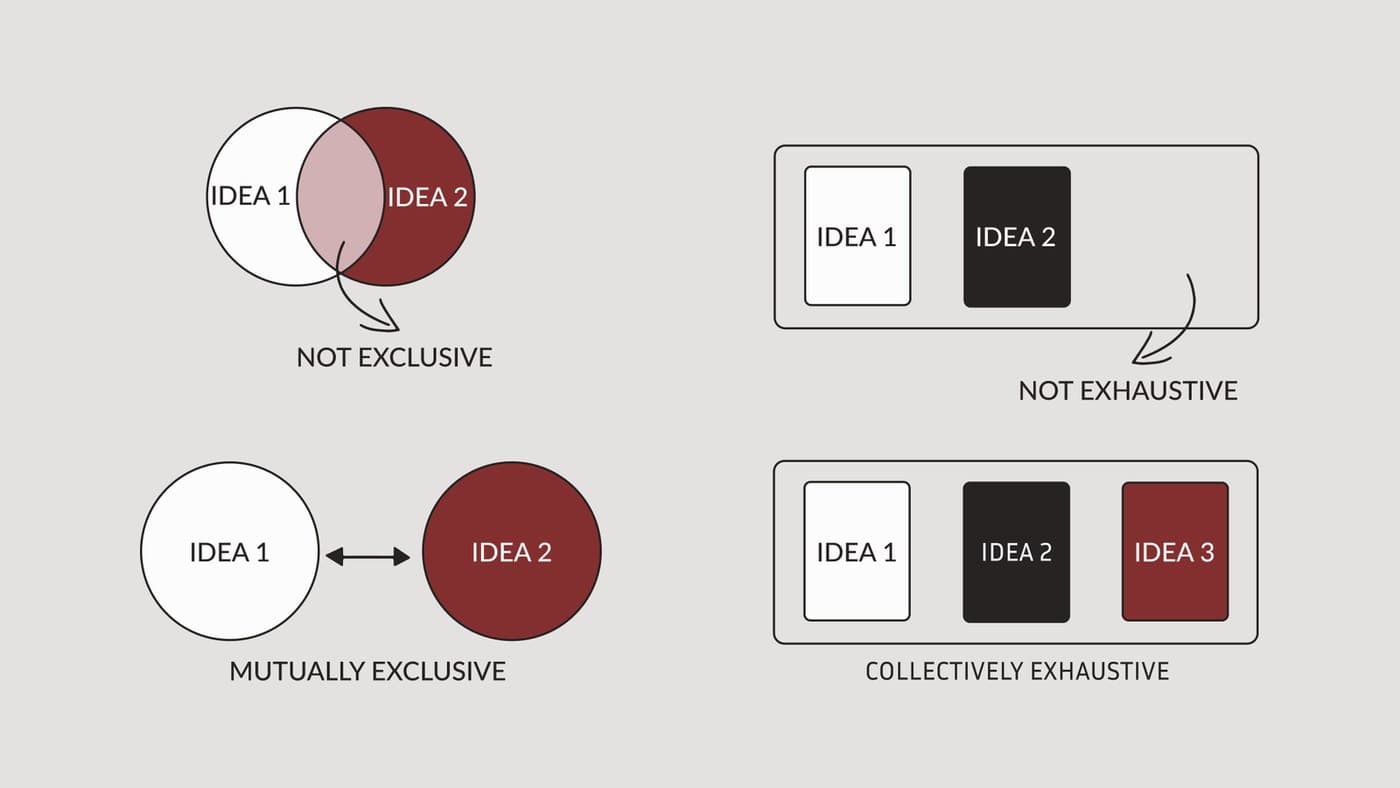
MECE
Break any problem into parts with no overlaps and no gaps. Every top consulting firm teaches it on day one.
Watch the free lesson: Introduction to MECE
Think Like a Strategy Consultant is a four-week course on how top consultants at McKinsey, Bain, and BCG communicate and solve problems.
30-day money-back guarantee · Lifetime access
 Taught by Paul Millerd, former McKinsey & BCG strategy consultant
Showing the before version
Hi! Quick update on the website. Design is basically done and looks great.
We had some back and forth with legal on the privacy page, and they're still reviewing it. Our developer was also out sick for two days last week. We're still waiting on photos from marketing, which is holding up the home page.
So we'll probably need about another week past Nov 7. Let me know if you have any questions!
Break any problem into parts with no overlaps and no gaps. Every top consulting firm teaches it on day one.
Watch the free lesson: Introduction to MECE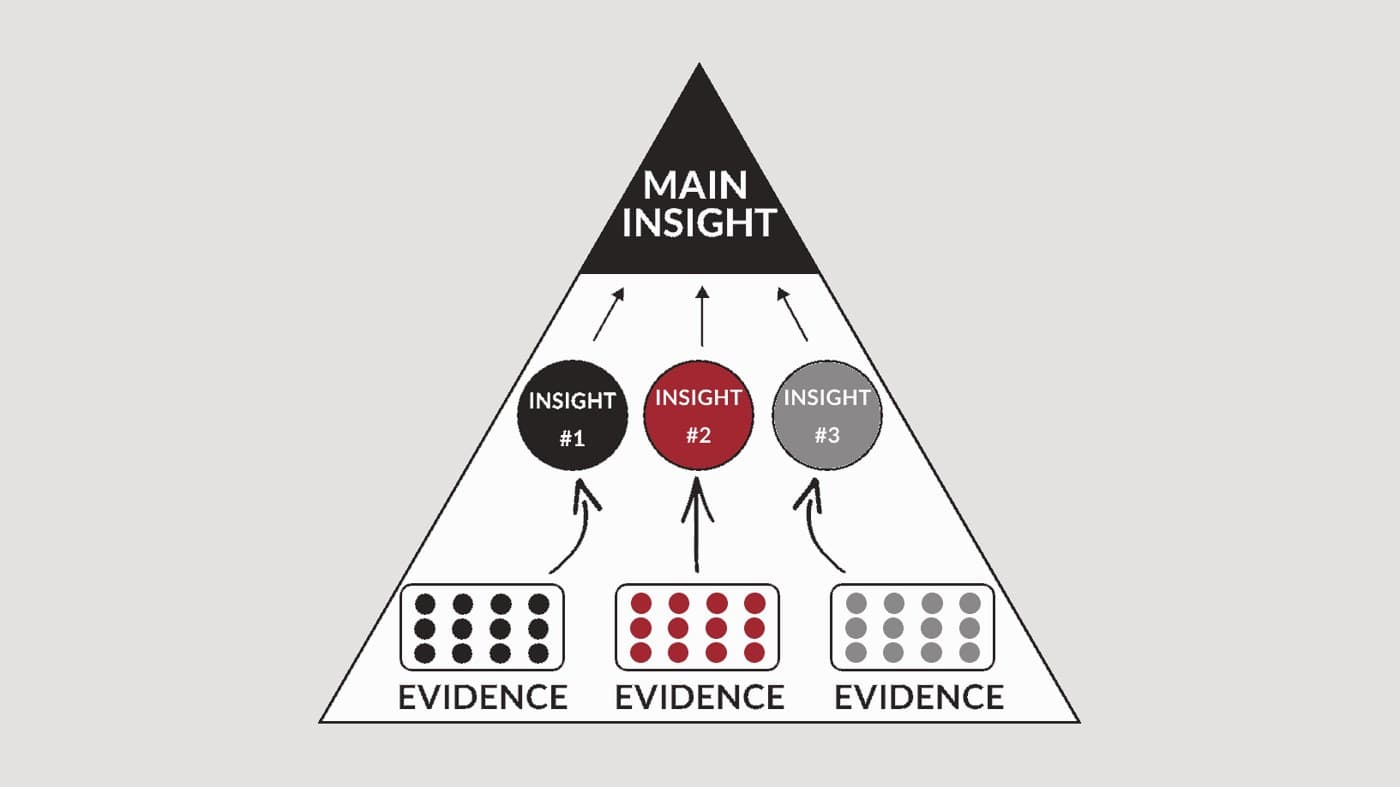
Barbara Minto's method from McKinsey for turning analysis into an argument people can follow. Every consulting presentation is built on it.
You'll practice it with LSI (Label, Sort, Insight), our own technique for going from raw notes to a clear insight.
Watch the free lesson: Label, Sort, Insight“The StrategyU toolkit is one of the main reasons I have a job in consulting. … From understanding the Pyramid Principle to making sure my analysis is MECE, I have used these principles in my jobs in consulting and finance.”
 Jeff, Ex-Bain & Company Consultant
MECE in practice: each branch is a separate question you can assign and answer.
The Pyramid Principle in practice: keep the facts that matter and say what they mean.
The title gives the conclusion and the chart backs it up.
Typical students spend 1–3 hours a week over four weeks, but all lessons are open from the start. You'll receive weekly email reminders once you enroll and can restart at any time.
Practice: a guided mini case
Assignment: sort a consulting firm's services, then find the three themes behind a company's morale problem
Assignment: build the issue tree for Facebook's shift to mobile
Assignment: turn 18 rough slides into a pitch that wins
You work with data, help shape your company's direction, solve complex problems, and present to executives.
You want to develop a strategy, communicate with senior leaders and boards, and set a vision with more confidence.
You never worked at a top consulting firm, but you do data-heavy or information-heavy work for clients.
You want to get better at problem solving and at communicating inside a company.
Sort a consulting firm's 11 services so nothing overlaps and nothing is missing.
It's 2012 and the world is going mobile. You are Zuck and the Board. Get the questions right.
Write the missing titles and call-outs so the story flows.
“This course helped me get promoted! It provides a framework to communicate complex business problems in a clear and concise manner. I wish I knew about MECE sooner.”
 Andrew K.
“It seemed I was not concise enough in my comms to the C-level, so this was a tremendous jump for me. I liked a lot the storytelling part and the presentation.”
 Wanda
“Full of relevant tools and case studies, this course is sure to help you create sharp, engaging and more persuasive presentations.”
 Amita
“Think Like A Strategy Consultant respects the principles taught in it: no fluff, straight to the point, impactful, exposing concrete and actionable tools, and conveying deep, meaningful messages.”
No sign-up needed. Each one has the full video and transcript.
 Start here: meet Paul, and why he made this course
Plus 4 short module intros.
This course pairs exceptionally well with agentic AI tools. In the past the challenge with learning these skills was a lack of feedback in real-world environments. Through the skills I built based on the course, you have access to a coach and sparring partner to push your own capabilities further.
Make a 30-page deck on Topic X from this spreadsheet
XLSX Topic X data.xlsxHi all, deck attached. Let me know your thoughts!
PPTX 30 slidesThat requires thinking like a CEO: defining problems, taking a hypothesis-first approach, and knowing how to coach and iterate.
| PartnerSet direction, judge the answer | You |
| Engagement managerShape the story and the workplan | You |
| AssociateDraft the pages | AI |
| AnalystBuild the analysis | AI |
This gives you something to react to. Now give it more guidance…
“Use the skill and use clearer and direct language, aim for one clear insight for the page”
“Show me different versions of this slide. Make the chart simpler. Show one clear bar that highlights the key message”
They work in Claude, ChatGPT, and other AI tools. Detailed walkthroughs for Claude Code and Codex show you how to learn from the AI, apply the skills, and build slides in an AI-native way.
Building slides in Claude Code or Codex? Try Decks, my free slide editor: you comment under a slide, and the AI makes the change.

I created this after 7+ years of facilitating workshops for corporate clients and student consulting groups. Over the past several years, I've improved this course and delivered it to 1,500+ people globally.
It is built on what I've learned from 10+ years working as a consultant, including time at McKinsey & Company and Boston Consulting Group, and as a freelance consultant in recent years.
I'm obsessed with synthesizing and simplifying ideas. This is the most efficient way I know to level up your skills as a knowledge worker or consultant.
I run this as a solo venture and love helping people learn these skills. If you have questions before you sign up, send me a note and I'll get back to you.
“I knew the Pyramid Principle already having worked in a consultancy firm. … The course was 1000 times better than the multiple times I did this elsewhere in the past. Highly recommended.”
$797
One-time payment for full course access.
$398 x 2
Same course, split over two monthly payments.
30-day money-back guarantee. If the course isn't for you, contact me within 30 days for a full refund.
“The best value for money course out there for young professionals to learn how to structure their ideas for executive reviews!”
Also available: Art of Strategic Freelancing ($347), or both courses as the Consultant's Bundle ($997).

“The course was a total game changer for me. I not only improved my understanding and the consultant approach to study cases but learned a more structured way to approach real problems effectively using the principles here explained.”

“I found the course to be a great resource which uses a self-paced approach to learning practical techniques & concepts consultants use. I am already applying what I've learned to create compelling analysis & recommendations to solve real business problems.”

“I was able to apply the principles taught in this program immediately. As a General Manager, it assisted me also to help others understand their problems better without directly jumping into solution mode.”
It's structured for four weeks, but you go at your own pace. Most people spend 1–3 hours a week, with more time in the weeks that have assignments.
Yes. Most students have never worked at a consulting firm. The course teaches the thinking and communication tools consultants use, and you can apply them in any knowledge-work role.
Yes. Once you enroll, you keep the course and all future updates.
Yes. If the course isn't for you, contact me within 30 days for a full refund.
The course teaches real-world strategy skills, not case interview practice. If case prep is your main goal, it's probably not the best fit. If you want the thinking and communication skills underneath, it will help.
30-day money-back guarantee · Lifetime access